Showing posts with label protest. Show all posts

Sunday, December 14, 2008

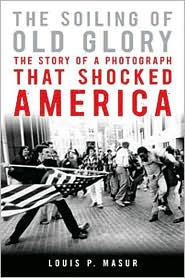
"The Soiling of Old Glory" Book

Book by Louis P. Masur

"Sometimes a moment can change history. This one took 1/250th of a second.

The photograph strikes us with visceral force, even years after the instant it captured. A white man, rage written on his face, lunges to spear a black man who is being held by another white. The assailant’s weapon is the American flag. Boston, April 5, 1976: As the city simmered with racial tension over forced school busing, newsman Stanley Forman hurried to City Hall to photograph that day’s protest, arriving just in time to snap the image that his editor would title “The Soiling of Old Glory.” The photo made headlines across the U.S. and won Forman his second Pulitzer Prize. It shocked Boston, and America: Racial strife had not only not ended with the 1960s, it was alive and well in the cradle of liberty.

Louis P. Masur’s evocative “biography of a photograph” unpacks this arresting image in a tour de force of historical writing. He examines the power of photography and the meaning of the flag, asking why this one picture had so much impact. Most poignantly, Masur recreates the moment and its aftermath, drawing on extensive interviews with Forman and the figures in the photo to reveal not just how the incident happened, but how it changed the lives of the men in it. The Soiling of Old Glory, like the photograph it is named for, offers a dramatic window onto the turbulence of the 1970s and race relations in America."

Busing's Boston Massacre by Matthew Richer

"A Boston judge's experiment in social engineering has unraveled neighborhoods and frustrated black achievement."

Video of Landsmark

Protests Continue


White racism rears its ugly head during the early days of the busing crisis.


Motorcade Protests

On October 27, 1974 a motorcade of approximately 700 antibusing protestors drove to the home of Gregory Ansig, Boston's State Education Commissioner to speak out against the school desegregation program. The majority of the crowd were from South Boston, but others came from different parts of Boston, as well as nearby suburbs. 

The original rally began at the Dedham Shopping Mall. The aforementioned 700 reached Ansig's house and began a smaller protest, while another 600 attempted to drive to the home of the judge who originated the ruling, United State District Judge Arthur W. Garrity. This group was turned back by the police before they reached their destination.

Coretta Scott King


The widow of the respected civil rights leader, Dr. Martin Luther King, Jr., spoke to a predominantly caucasian crowd at a rally on the Boston Common on December 1, 1974. Her speech was the climax of a march and rally, which led demonstrators in support of the busing plan from the state house to city hall. She argued that the recent acts of violence against desegregation were more detrimental to national welfare than the busing itself. 

"Can anyone believe that people using or condoning acts of violence as well as vulgar racial epithets are making a democratic protest against busing? No. They are making a un-democratic assault on equality."

King was joined by Representative Robert Drinan, a Democrat from Massachussetts who also addressed the crowd.

Saturday, December 13, 2008

Theodore Landsmark


Theodore Landsmark was born May 17, 1946 in Kansas City, Missouri. He moved to New York as a child, where he attended Stuyvesant High School and St. Paul's Preparatory. He attended Yale for college, where he earned a BA in political science, before continuing on to Yale's law school. A veteran of civil rights advocacy, Landsmark had marched from Selma, Alabama to Montomery, Alabama in a civil rights march, and had also attended Dr. Martin Luther King Jr.'s funeral.  
On April 5, 1976, Landsmark was going to a meeting at City Hall. As he entered City Hall Plaza, a protester spotted him and yelled a racial slur at him. Another protester punched Landsmark and he fell to the ground. As he got up, Joseph Rakes came after him with and American Flag and hit him with it several times. This entire incident lasted between fifteen and twenty seconds.
The attack broke Landsmark's nose, as shown in the photograph above. At the hospital, Landsmark requested that his nose be bandaged in a way to draw maximum attention.
At a press conference he held two days after the incident, Landsmark said he did not blame the students who attacked him. He labeled them as "poor, working-class victims of a system that used race to mask deeper economic divisions in American society." 
The incident turned Landsmark into a local celebrity and he became a spokesman for racial tolerance. 
Landsmark is currently a lawyer in Jamaica Plain.

Student Protesters

Before student protestors went out to City Hall Plaza, they gathered in city council chambers. There, Louise Day Hicks served the students hot chocolate and led them in the pledge of allegiance, depicted here.